

Understanding the Nature of Decisions
To introduce what Configena aims to address — and what the Configena Framework is designed to support — consider the following list:
- The energy‑efficient renovation of a house
- The design of a playground
- The redevelopment of a district with an integrated energy system
- The design of a garden
- The creation of a new airport
- The introduction of a new container ship
- The redesign of a kitchen
- The launch of a new product line in the white‑goods segment
- The redesign of a corporate identity
- A family vacation
At first glance, these examples have little in common. What should a family holiday have to do with building an airport? Or the renovation of a house with the redesign of a corporate identity?
The subtitle suggests that the common thread lies somewhere in the art of decision‑making. But this is not about choosing between pizza and curry for lunch. Nor about decisions of love, belief, or personal taste.
So what is it really about?
A Shared Structure Beneath the Surface
The connection between these examples lies deeper — not in a single point, but in a constellation of characteristics that appear across all of them.
1. A need or desire as the starting point
Every initiative begins with a need. It originates in an individual, even when it later becomes a shared intention.
2. An idea of a changed future state
Each example starts with an idea — a mental image of how something could be different from the current state.
3. Dependence on multiple actors
None of these undertakings can be realized alone. They require the involvement and cooperation of several people.
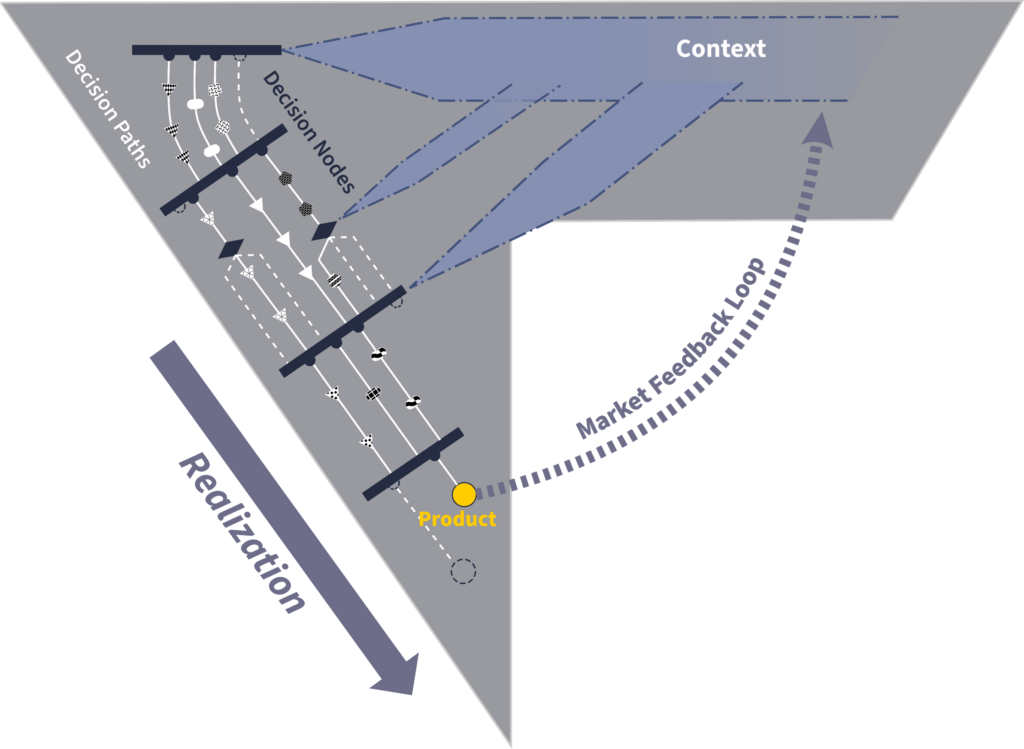
4. A path of decisions
Between idea and realization lies a chain of decisions. Each decision creates further dependent decisions.
5. Criteria and consequences
Every decision has consequences and can be evaluated against different criteria. Only the full decision path reveals the complete picture.
6. Projection into an uncertain future
Decision paths always extend into the future and are therefore uncertain. They rely on assumptions about developments that cannot be fully known.
7. Context shaped by past experience
These assumptions are grounded in past experiences and knowledge. They form the context that is projected forward.
8. Communication and shared conviction
Actors must develop a shared understanding and conviction about the path forward. Communication is essential.
What Configena Does — and What It Does Not Do
Configena cannot and will not make decisions for anyone. It does not advise on love, clothing choices, or bedtime routines. It does not decide — it provides the methodology, and later the tool, for decision architecture and decision processes.
If the goal is to support the art of decision‑making with a tool, then the characteristics above must be addressed. And any improvement must be considered in the whole: strengthening one aspect may weaken another. A framework that supports all these characteristics must also provide a way to balance them.
How Decisions Unfold
To understand this, the characteristics above must be seen as parts of a process — or several interconnected subprocesses.
A decision begins with an idea. It is usually abstract, not tied to concrete forms, often linked to an imagined emotional or experiential state in the future.
Next, the context is identified and defined. Within this context, certain options appear — not because they were consciously chosen, but because they are present and available. Additional information is gathered and integrated.
At this point, exploration becomes possible. Information includes rules — not formulas, but exclusion criteria. Certainties do not need to be explored. Rules may simply be personal experiences reflected in preferences.
Communication follows. Participants do not share the same information, nor the same personal rules or preferences. Only when a shared understanding of the context emerges can decision points be defined and agreements reached.
Exploration here means considering variations of possible manifestations. Not all variations are examined; many are excluded implicitly by rules. People make countless unconscious decisions every day — not expressed as formal rules, but still rule‑based unless randomness dominates.
The Core Dilemma
Configena focuses on conscious decisions. The dilemma is clear:
- The informational context is the basis for decisions.
- But it is impossible to examine all variations.
- With multiple actors, the information space grows even further.
- Humans dislike large choice sets — they are cognitively demanding.
- Technically, evaluating many variants is often not economically feasible.
Only constraints make the exploration of a design space manageable.
Where Configena Comes In
Design and creativity require space. But design becomes real only when others support it. Others expand the design space — and restrict it at the same time. Constraints can hinder, but they also guide. They make exploration possible and form the basis for implementation.
This is exactly where the Configena Framework — and later Configena Studio — will support the process.
A Simple Illustration: Designing a Kitchen
Consider the redesign of a kitchen:
- It begins with an idea: more space, more light, a different style.
- Then comes the context: room dimensions, connections, budget, habits, preferences.
- Information enters: materials, appliances, delivery times, costs.
- Rules act as filters: “This doesn’t fit”, “This is too expensive”, “I don’t like that”.
- Variants emerge and are discarded.
- Finally, several actors — residents, craftsmen, planners — must develop a shared understanding.
What emerges is a decision space.
Configena makes this space visible, structured, and explorable.
What Configena Studio Will Enable
Configena will not make decisions. It will provide a tool that:
- makes context visible,
- structures variants,
- makes rules transparent,
- enables exploration,
- and supports communication between actors.
Design needs space. Decisions need structure.
Configena brings both together.