
Some time has passed since I announced that my next blog post would look at examples of what holistic product management might look like and how Excel could even help with it. A lot has happened behind the scenes in the meantime. As with almost any development, the work does not just lead to solutions; it typically also raises new questions, which lead to new tests, which in turn bring new challenges and, quite naturally, new ideas.
Without discipline, there is a risk of giving new ideas so much attention that the original goal is lost from sight. Agile working, however, also requires us to incorporate new insights and respond to them. Who would want to accuse themselves of being sluggish rather than agile? That would also provide a ready-made excuse for having been led astray by new ideas instead of bringing things to completion as intended.
In short, new insights and challenges have led me to respond to them in an agile manner and at least evaluate them. In keeping with the motto: Thoroughness before speed. Lilu says I really am never short of an excuse.
Undoubtedly, these developments also include the ongoing advances in AI.
To correct any possible misconceptions right away, it should be said that AI has been and continues to be used extensively in various areas of Configena from day one. More powerful AI models, combined with agent systems and automation, have become significantly more capable over the past few months. This gives rise to concerns, but when coupled with a wide range of tools, it also enables diverse forms of automation and, as a result, massive increases in speed.
This inevitably raises the question of whether the approach pursued by Configena is still relevant at all and, more importantly, whether it has a future. Closely related to this is the further question of how AI—with a considerably more positive connotation—should be integrated into decision management.
In addition to questioning my own approach, I have also received critical questions and comments about it. Addressing these very questions and comments is what this blog post is intended to do.
In theory, I could refer to my last few blog posts—the answer was essentially already there. Apparently, though, it was not quite obvious enough for an explanation to be of some help, at least as a form of helping people help themselves.
It would actually be Lilu’s responsibility, as Chief Logic and Advisory Officer, to take care of this task. What can I say? She thinks an explanation would bring no new insights, since the answer should be clear to anyone capable of even the simplest deduction. As a triviality, it simply does not fall within the remit of a CHIEF Logic and Advisory Officer.
Did I mention that I am also something of a CHIEF myself—or, to be precise, her boss? Never mind. Lilu is Lilu.
I would not want to be without Lilu. But since she is not here right now, perhaps I can say a little more about her without being met with a withering glare.
When I was a child, there was a cooking show in which the host—as far as I remember—invited various famous people to cook and eat together. Two things I remember very well: first, the host was never averse to a glass of wine during the show, and second, when describing dishes that apparently did not quite suit his taste, he used the euphemistic word “interesting.” A description that might itself be considered “interesting” in this context, since it was left entirely to the viewer to interpret what he actually meant.
Applied to Lilu, I would certainly not be saying anything untrue if I described her as sometimes a little “special.” Naturally, one might be tempted to compare her with other well-known real or fictional characters. That would do neither her nor, in my view, anyone else justice. It is all too easy to attribute further characteristics that simply do not apply. Still, to give you an idea of what Lilu is like, I will have to leave a few things out.
As her role at Configena might suggest, she is exceptionally sharp-witted.
Parties and events involving lots of people are not really her thing. Not that she dislikes socialising; it is just that these kinds of events tend to be rather superficial, which bores her and consequently leaves her strained and exhausted. She has little need for self-promotion, either—and in her observation, that seems to be precisely what such events are all about. She observes and analyses. When obliged to make small talk, she says what she sees. And because Lilu is Lilu, she also says things that simply follow logically from her observations. She usually attaches no particular significance to these observations and conclusions. Others, however, do—according to a very particular set of ideas and principles that only becomes apparent later. This leads to absurd and, from the outside, bizarre situations, often ending in considerable chaos. In short, whenever she can, she avoids these gatherings.
Not attaching particular significance to things does not mean that she is indifferent to everything—quite the opposite. Justice matters enormously to her. Not as a means of giving meaning to one’s own existence through some metaphysical beings and rules that elevate the person calling for justice above others, but as a principle of order. Equality is not her supreme maxim, but whenever a comparison is made using equality as its benchmark, the relationship has to be consistent.
She does not take herself too seriously. Nor does she take others too seriously. Her dealings with authorities and imposed rules that show little consistency or plausibility lead her into quite a few conflicts. Her sense of humour, which in such situations takes the form of pronounced sarcasm, rarely does much to defuse them.
On top of all that, she is exceptionally curious, freedom-loving and adventurous. Lilu is Lilu.
And since Lilu did not consider it her responsibility to provide the explanation, and is not here either, she will simply become part of my explanation herself. She has only herself to blame, I can only say. She has just said goodbye as well, informing me that she is flying to Argentina to meet Pepe. After all, she can continue working from there over the next few weeks. Did I mention that she does not think much of rules whose plausibility she cannot see? Visas, tax law, liability insurance…
At least this gives me an opportunity and an incentive to slowly—veeeery slowly—get to the actual topic.
To understand what follows, you need to know that Pepe can probably be described as one of her closest friends. They share a love of freedom, a sense of justice and a thirst for adventure. In every other respect, they could hardly be more different.
Pepe is extremely sociable and charming. He enjoys dancing, music, good food and, more generally, life itself. Spontaneity and intuition guide him, and he does not worry about tomorrow. He is an artist, and his sense of aesthetics stems from feeling rather than formal principles. If one were looking for an example to explain what a bon vivant and hedonist is, he would be very high on the list of candidates.
Perhaps it is not so much their similarities that make their friendship so strong. Perhaps it is precisely these differences and the symbiosis that emerges from them. Or perhaps it is simply a combination of both: their similarities provide the fertile ground in which that symbiosis can grow.
The following photo shows the two of them during Lilu’s last visit to Buenos Aires.

They spent only a few days in Buenos Aires before travelling on to Pepe’s home in the province of Córdoba. In Córdoba Capital, the provincial capital that gave the province its name, Pepe owns his own studio—right on Plaza San Martín, overlooking the equestrian statue and the cathedral.
Especially in the Southern Hemisphere spring, when the jacaranda trees put on their purple floral robes, the view from his studio window provides Pepe with inspiration for his work. Lilu was eager to see his latest creations, even if she did not always understand them. But then, how could she? Pepe painted by feeling. Lilu, on the other hand, looks for an underlying order in his paintings, one that merely needs to be deciphered. It is an expression of her hope that, by doing so, she might come to understand him more deeply and feel closer to him. His behaviour and way of being remain a mystery to her.
Pepe feels much the same way about Lilu. The only difference is that he does not look for order; instead, driven by the same desire, he wants to develop a deeper intuitive understanding of her. One might suspect that it is precisely this distance between them that gave rise to the attraction they feel for each other in a platonic sense, and that continues to sustain it.
It is therefore hardly surprising that Lilu would have been perfectly happy spending time alone with Pepe, eating empanadas at one of the many small restaurants and bistros—vegetarian, of course—and talking with him about the colour palette and visual language he had chosen for his paintings.
It is equally unsurprising that he wanted to proudly introduce her to his friends in the local art scene and let her share in the carefree abandon and emotional exhilaration he experienced when dancing to music.
In the end, his enthusiasm proved infectious. After all, a warm spring night was in store, and there would surely be plenty to discover to satisfy her curiosity.
The plan was to visit the flea and craft market, the Paseo de las Artes, first, then head to Casa de Pepino in Güemes, the city’s arts and nightlife district, and take part in the Circuito de Arte.
Despite looking forward to the evening, she also had some reservations. She was used to people commenting on her blond mop of hair. In Argentina, however, it made her stand out even more. She was not embarrassed by it; she simply disliked being the centre of attention when conversations were about her rather than with her.
When her blond hair became a topic of conversation, she liked to explain that, despite her African origins, she was a direct descendant of the great and wise mammoth Eiríkr Mammutson, known as Hårfagre (“Fairhair”).
Pepe enjoyed teasing her about this and suggested that perhaps one of her female ancestors had got a little too carried away with a blond warthog. She usually let that pass without comment.
Only once had she replied, alluding to a well-known Mexican fast-food dish, that he had better be careful, or she might suggest a Burrito Argentino—after all, genealogically speaking, he was somewhere between a goat and a bovine. To understand this, one must know that before they can find their blessed rest after death, both animals are guests of the asador—the grill master.
Pepe had been silent after that.
As it turned out, her concerns were not entirely unfounded. Only a few of the market stalls really caught her attention, prompting them to stop and linger. One of them offered a motley assortment ranging from handmade wooden toys, antique devices, clocks and measuring instruments to new logic and 3D puzzles made of balsa wood.
There were also several children at the stall. Among them was a girl who looked about ten and a somewhat smaller boy of perhaps six or seven. It was difficult for Lilu to estimate their ages, since people generally looked rather small to her anyway.
In any case, she noticed that both children were facing her and had quite obviously started whispering while looking in her direction. Unlike with adults, this did not bother her when children did it. Whenever the situation allowed, she confronted the whisperers directly in either case. The difference was that with children she gained new fans, whereas with adults there were occasionally tears. Her quick wit, combined with her sarcasm, could be cruel.
This time was no exception—no tears, but two new fans. The children were standing in front of an antique harmonograph, with no indication of what the device was for. There was no paper on it and no pen attached. The seller probably did not know what it was himself. Lilu, however, recognised it immediately. With a flick of her short trunk, she asked Pepe for paper and a pen and demonstrated how it worked—not just for the children, but for everyone standing around.
For readers less familiar with the subject, a harmonograph is shown below. Among other things, it draws Lissajous figures—geometric curves that can be understood, in a sense, as projections of coupled oscillatory motions.

https://en.wikipedia.org/wiki/Harmonograph
This was how she quickly broke the ice with the children—naturally, not without telling them about her famous ancestor, Eiríkr – Hårfagre – Mammutson. As she did so, she gave Pepe a look that would have made it clear he would become the proverbial burrito that very evening if he dared say a word. In fact, however, he paid no attention to her at all and did not hear the story. The shapes drawn by the harmonograph had completely captivated him.
He was equally oblivious to the conversation between Lilu and the father of the two children, who had meanwhile joined them. It turned out that Jorge, the children’s father, worked as an astrophysicist at the OAC, the Observatorio Astronómico de Córdoba.
Without going into all the details of their conversation—I couldn’t anyway, since I wasn’t there—it seems that the main topics were planetary orbits, the history of astronomy, and the explanatory power and characterisation of physical models. In any case, the conversation ended with an invitation for Lilu to give a guest lecture to students and other interested visitors at the historic and still active Observatorio Astronómico de Bosque Alegre, in the nearby Sierras.
Naturally, Lilu and Pepe were also personally invited to have a meal with Jorge’s family. But that is not what this story is about.
The lecture, which was to take place about two weeks later, was to be entitled Astronomy at the Transition from the Age of Direct Mapping to Deductive Knowledge.
Did I mention that Lilu wasn’t on holiday even then, and that any outside activities—even unpaid ones—required my consent? By now, I suppose I have to admit that I have lost all authority over her. What can I say? Let’s return to the lecture and its subject matter. Much like the paths drawn on paper by the pen of a harmonograph, planets move along orbits. Unlike the pen, however, they leave no visible trace in the firmament. Their orbits only became visible when the positions of celestial bodies were plotted and the time between cyclically recurring events was measured and related to those positions.
With the harmonograph, we can see the mechanism. We can see the chains from which the drawing board is suspended, and based on experience, we have at least a rough idea of how the board will swing when given a push. Yet the paths it draws can still fascinate us. They reveal a structure that follows an ordering principle and obeys a higher principle of symmetry, even though we cannot predict the precise trajectory simply by looking at it—especially since it depends on the settings and on how the mechanism is set in motion.
Now imagine that we knew nothing about the mechanism. We would see only the resulting curves. Translated to the motion of the planets, this was the situation at the end of the sixteenth century, when Tycho Brahe began observing planetary orbits. His data led Johannes Kepler, in the early seventeenth century, to formulate the three laws that now bear his name.
Translated back to the harmonograph, Kepler’s achievement would be equivalent to describing the curves using mathematical equations, with the observations having been made aboard a moving train whose motion introduces all kinds of disturbances.
Unlike Kepler, however, we know how the harmonograph works—and, more importantly, we now know the physical laws from which we could derive the equations. We owe this knowledge largely to one man: Isaac Newton.
Almost eight decades passed between the publication of Kepler’s first two laws in 1609, which describe the geometric shape of planetary orbits and their timing, and Newton’s publication of Philosophiæ Naturalis Principia Mathematica in 1687. Newton’s axioms made it possible to derive Kepler’s laws from more general statements—to deduce knowledge from them.
This is the period Lilu’s lecture was to focus on. Unsurprisingly, observations did not cease during these decades. On the contrary, they were advanced by developments in instrument-making, among other things, and alternative descriptions were proposed as well. And just as unsurprisingly, Pepe remained completely unaware of Lilu’s thoughts on the matter.
One of the astronomers of that period who also studied planetary orbits was the Italian-French astronomer Giovanni Domenico Cassini, director of the Paris Observatory. Like many scholars of his time, he was naturally more than “just” an astronomer; he was also, of course, a mathematician and engineer. The term physicist did not yet exist. It would hardly have fitted with the claim that he may initially have worked as an astrologer, too. I cannot say whether the information I found about that is accurate, however. Among his achievements was the discovery of four of Saturn’s moons. His accomplishments went beyond that, of course, but they do not require me to explain anything further here.
He was not particularly convinced by Newton’s law of gravitation. Whether he was equally sceptical of Kepler’s laws of planetary motion, or had simply come to believe he could do better, I cannot judge. In any case, he proposed alternative models—the curves now named after him, the Cassini curves.
Lilu was probably impressed by this attitude of his: “Nah, I can do it better, and I don’t care what anyone else thinks.” At the same time, she wanted to understand his objections. After all, we are talking about Newton. She therefore decided to include Cassini in her lecture and give the curves named after him a prominent place on the title slide.
She decided to ask Pepe for help and involve him in designing it. After all, he was the artist of the two. Did I mention that he had paid no attention to the conversation between Lilu and Jorge?
After the weekend, she turned up at Pepe’s studio and explained what she wanted him to do—without repeating the context. After all, he had been there during the conversation with Jorge.
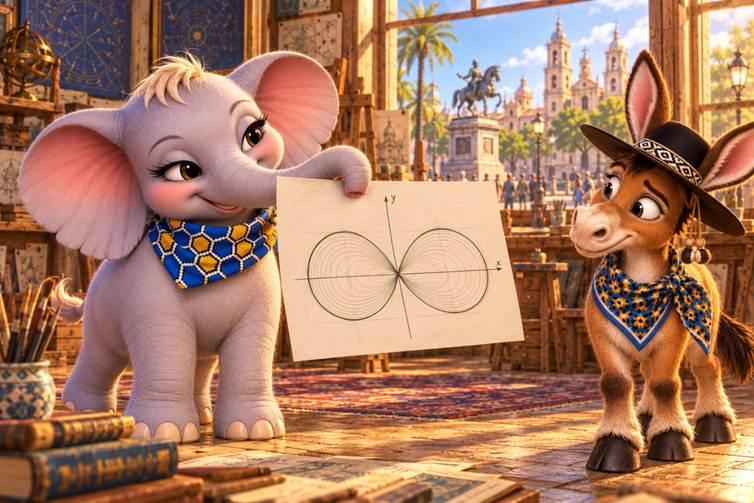
He knew the title, but what on earth was he supposed to make of “Astronomy at the Transition from the Age of Direct Mapping to Deductive Knowledge”? “Direct mapping”?! “Deductive knowledge”?!
He didn’t want to ask Lilu, either. Then she would have known that he hadn’t been listening.
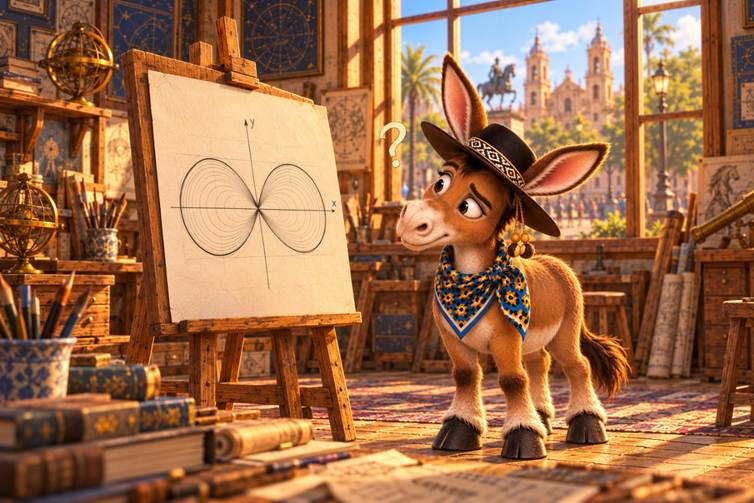
Just as Lilu is Lilu, Pepe is Pepe. And Pepe wouldn’t be Pepe if he didn’t let his intuition guide him. So he came up with what he considered a brilliant idea—one that was bound to fit.
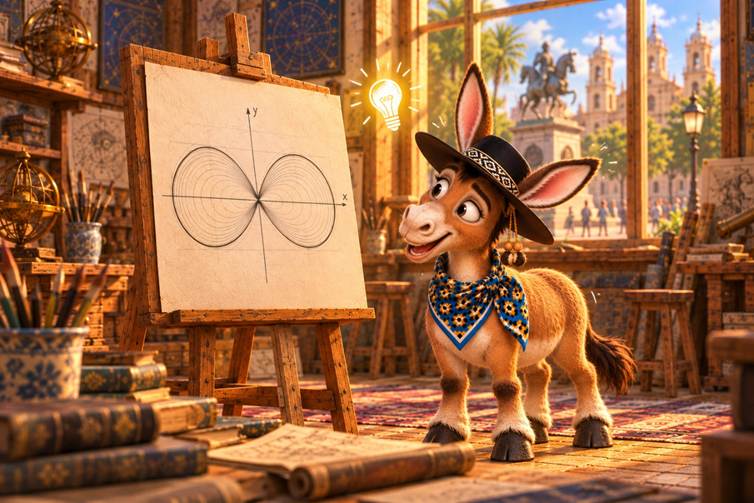
The result of his intuition has been preserved.
Let’s take a look at the result together and let it sink in for a moment.
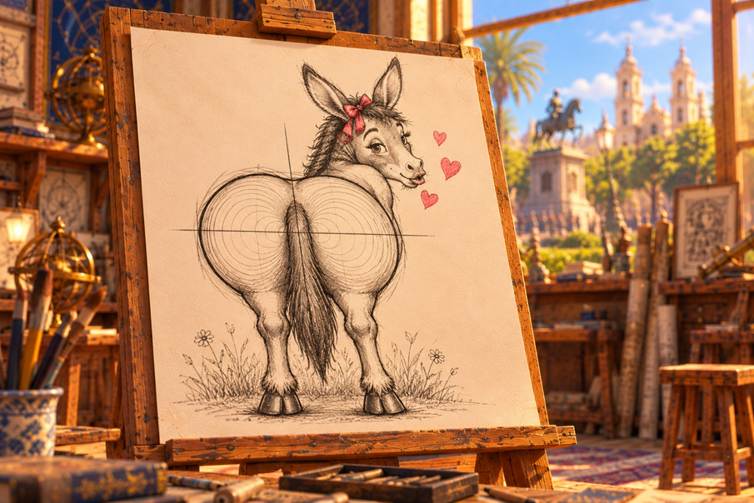
I probably don’t need to point out that the result did not exactly match Lilu’s expectations.
Most readers—at least those who have stayed with me attentively this far—will probably have little difficulty understanding Lilu’s reaction. Although “surprise” is not quite the right word. In any case, the result was not what she had expected or hoped for. This had nothing to do with formalised quality criteria or Lilu’s personal taste. It had to do with the content and the underlying interpretation.
Lilu had given Pepe a task, with an expected result specified by only a few criteria. Exactly the same thing is increasingly happening when we communicate with AI and commission it to create texts, images, films, or even entire programs. Personally, I find the results impressive! And yet, quite often, I find myself in a situation similar to Lilu’s with Pepe. I doubt I am alone in that.
My impression, however, is that this is not because AI has yet to reach full maturity. That may well be true—just as Pepe’s artistic skills may not yet have reached the level of a Leonardo da Vinci. But that is not what causes the discrepancy between expectation and result. The problem is semantic.
As I explained in my previous blog post, semantics consists of a chain of mappings to information. It would therefore also be wrong to assign blame. The transfer of meaning presupposes a shared understanding. Communication takes place within a context. When two conversation partners operate with different contexts—that is, start from different assumptions—it is not enough to convey only the intended message. The differences in their assumptions must also be communicated, insofar as they are needed to interpret the message correctly.
This is comparable to an encrypted message that requires the correct key to be decrypted. The key, in this case, consists of the differences between the contexts. Identifying those differences is the challenge.
In this example, Pepe could have asked Lilu. But he didn’t, because he didn’t want to expose himself. We can probably assume that this is not the case with AI.
One can certainly imagine that developers or providers might use more critical algorithms in the future. It seems unlikely, however, that they will do so, since the strength of these systems lies precisely in delivering answers and results very quickly. When you ask an AI to generate an image, you don’t do so by specifying every last detail. This illustrates the advantage of not having to describe everything precisely, but instead allowing generative AI to explore possibilities and make its own decisions.
At the latest when AI agents with assigned roles are deployed, it should at least be conceptually possible to implement follow-up questions when needed, provided that this is part of an agent’s assigned role. This must not be done indiscriminately, however, but in relation to a context that is defined and can be retrieved.
Let us assume that, in many cases, we could easily identify situations in which questions are necessary because context is missing. Even then, the problem would remain in all the other cases.
I would therefore like to present an example that everyone can try for themselves.
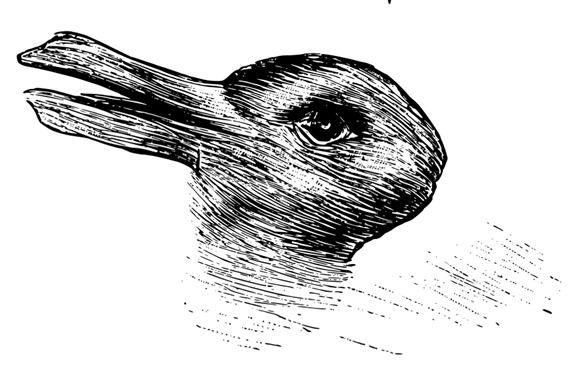
An animal is shown below. The instruction given to the AI is to depict the animal in its natural habitat and identify it.
Here is the image:
https://en.wikipedia.org/wiki/Ambiguous_image
This is what is known as an ambiguous image, or an optical illusion. Two completely different interpretations are possible: a duck and a rabbit. One and the same person can perceive both—but not at the same time. Our brains have, so to speak, two recognition states. I cannot say whether this applies to everyone. There is therefore no right or wrong interpretation of the image in itself.
Here is the response the AI generated for me.

The image used is, of course, well known, and one might have expected the AI to recognise it and ask a clarifying question on its own initiative. Instead, it chose the duck without asking. Something else is interesting, too: rather than simply using the original sketch and embedding it in the result, the AI generated a photorealistic image, which I had not asked for. It also incorporated text into the image. And one more thing happened: it selected a specific species and depicted a male animal.
The AI does not merely fill in missing information. It makes decisions that determine both the content and the form of the result.
As long as we are dealing only with images of this kind, or simple texts that are checked beforehand, this is sometimes just an annoying matter and sometimes an amusingly absurd one. But as soon as complex programs are created or AI makes decisions within automated processes, the results can have serious negative consequences.
Decisions build on previous decisions, creating path dependencies. The more complex the architecture of generated structures and processes becomes, the more likely it is that errors will remain undetected until their effects become apparent. Increasing the speed of decision-making does not guarantee better decisions or fewer errors.
AI does not diminish the importance of the challenge Configena is designed to address. On the contrary, AI makes Configena even more important. Only decision-making processes that are comprehensible and tied to controlled conditions enable the sustainable use of AI for demanding tasks. Configena aims to contribute to this.
Finally, there is just one thing left to explain: how the story of Lilu’s lecture continued.
Anyone who thinks she reacted angrily when Pepe presented his work to her has yet to understand Lilu. Was she surprised? Oh, yes! Was she taken aback? Absolutely.
Then she laughed, thanked Pepe, and decided to use his work on the title slide after all, under the title Astronomy at the Transition from the Age of Direct Mapping to Deductive Knowledge.
On the evening of the lecture, Jorge introduced her to the audience in the presence of his boss and the members of the governing board. When Lilu then showed the slide, he was certain that he would have to find work at his brother-in-law’s dumpling factory from then on—his scientific career would come to an abrupt end that evening.
His fears soon faded, however, as Lilu delivered her lecture. She guided her audience confidently through Kepler and Cassini to Newton without mentioning the unexpectedly different title slide until shortly before the end. She acted as though no other representation could possibly fit the title.
Then she revealed the reason behind it, offering the charitable hypothesis that the relationship between Cassini and Newton might have been rather like the one between Pepe and herself: simply a communication problem arising from different contextual knowledge.
She then showed her particular appreciation for Pepe by devoting the conclusion of her lecture to Asellus Borealis and Asellus Australis—the northern and southern donkeys in the constellation Cancer—and explaining how, according to Greek mythology, they had been placed in the heavens as a reward for helping Dionysus.
That, too, is Lilu.
The next post will turn to the methodology and example implementation announced in the previous article.
Lilu and Pepe will continue to appear on this blog to illustrate concepts, but their stories will no longer be explored in such depth here. Their adventures will be developed further elsewhere.
So, stay tuned! 😊
Leave a Reply